(UK Government; “New Vision for Refugees” from 7 March 2003)
„A new vision for refugees“
„A new vision for refugees“
RESSOURCES
Tony Blairs Anschlag auf den internationalen Flüchtlingsschutz
Tony Blairs Anschlag auf den internationalen Flüchtlingsschutz
L’attaque de Tony Blair sur le droit à l’asile politique (FR)
Tony Blairs assault on international refugee protection (GB)
siehe auch:
Vor zehn Jahren: Die Demontage des Grundrechts auf Asyl (Presseerklärung vom 25.05.2003)
SUMMARY
1. A Long Term Vision of a Managed Global System
The proposed new vision for refugees is a global vision that meets both our international obligations and is responsive to domestic political and economic concerns. Our approach is based around the principle of trying to better manage the asylum process globally, breaking the link between illegal immigration and asylum seeking, providing greater certainty for governments and more equitable protection for the majority of refugees. It is a pro-refugee but ant-asylum seeking strategy.
Principally we propose providing better protection in source regions for the great majority of refugees who remain there. We will continue to take refugees but on a managed basis processing applications in these source regions. Central to this approach, and in the interests of equity, we would also return those who apply for asylum here to these source regions for protection and potentially processing. Movements away from source regions would take place through managed refugee resettlement programmes enabling more effective integration of refugees. We argue that alongside better protection, large flows of genuine refugees from countries should be seen as a legitimate trigger for international action in source countries. This should be seen as a legitimate trigger for international action in source countries. This should include diplomatic pressure, offers of development aid, suspension of membership of international bodies to conflict resolution processes and military action as a last resort.
1.1. The current system is failing
We start from the premise that the current global system is failing because:
- Support for refugees is extremely inequitable, with asylum seekers who make it to the UK frequently receiving support and legal costs exceeding $10, 000 a year, whereas the UNHCR only spends an average of $50 a year on each refugee or other ‘person of concern’ around the world.
- The current asylum seeking system usually requires those fleeing persecution to enter the West illegally, in most instances paying criminal organisations many thousands of dollars (facilitating cross continental illegal movement usually costs between $5000 – $15 000)
- Between a half and three quarters of those claiming asylum in Europe do not meet the criteria of full refugees, whereas there are 12 million genuine refugees in the world according to UNHCR;
- It is extremely difficult, time consuming and costly to remove those without a valid claim, which undermines public confidence in the system and increases the attractiveness to economic immigrants;
- Individual countries experience rapidly fluctuating and unmanaged intakes of asylum seekers and refugees, often resulting in poorly resourced and ill thought through responses which cause problems for genuine refugees, and leave public services and communities struggling to meet their needs.
These issues are well recognised internationally. The UNHCR has made similar points about the significant problems with the current systems. But most countries are focusing on their own systems, rather than a better international system and the focus of European action to date has been on minimum standards and third country movements, albeit with some emphasis on actions in source regions. But a Common European Asylum System remains a clear goal and is likely to be defined in the new Treaty. There may now be a rare opportunity for the UK to truly set the global agenda on this issue.
1.2. The Proposed Protection Package
We believe that the UK should promote the development of a better-managed international system. The proposals we outline below are generally compatible with the direction of thinking in the UNHCR and the Lisbon agenda that the UK has started to set out. They do not require any change to the Geneva Convention or ECHR. Our proposed approach does not require partnership arrangements between States currently receiving asylum seekers, host States in the regions who bear the brunt of the refugee endorsement of the new system would be necessary.
The first element of the new system would be improved protection in the regions in Regional Protection Areas. The vast majority (over 90%) of refugees already remain in the regions close to their country of origin. The Regional Protection Areas would be safe areas where UNHCR has responsibility for providing protection and humanitarian support to refugees. The standard of protected provided must be to Article 3, ECHR levels. There must be safety from persecution, inhuman and degrading treatment within the Protection Area and assurance that no one will be removed from the Area to face such treatment elsewhere. The type of Protection Area would vary according to the Region and the host country. In some cases refugees may simply be supported in local communities, in others there may be dedicated refugee settlements. A balance will have to be struck; the protection for refugees must be satisfactory to meet the test of Article 3 but must not create envy or mistrust for neighbouring communities in the host state, or provide an incentive to migrate because of the facilities on offer. Nevertheless, for a genuine refugee it would meet the basic requirement of providing protection.
The second and important element of the system would be that those who claim asylum in the UK or in another participating country would usually be returned to a Regional Protection Area in their source region. For example, Iraqis who claimed asylum in the UK could be moved to a Protection Area in, say Turkey, Iran, or the Kurdish autonomous Protection Area. In such an area they would receive protection and could in due course, apply for a resettlement place. In order to make such removals the norm, the courts would need to be persuaded that such removal was in compliance with the Geneva Convention and Article 3, EHCR. This should be possible if the standard of protection provided in the Regional Protection Areas can be shown to be secure, and Protection Areas are both endorsed by UNHCR and are categorised as safe in domestic legislation. If Regional Protection Areas have sufficient coverage immediate returns to the Areas should significantly and rapidly reduce the number of economic immigrants using asylum applications as a migration route into third countries. It would simply not be worth their while and the whole risk calculus would shift against trying to reach the UK.
The third element of the proposed protection package would be international recognition of the need to intervene to reduce flows of genuine refugees and enable refugees to return home. This would be a graded response, focused initially on assistance to the source country, moving to coercive intervention such as requests for a formal explanation at the UN, to sanctions, and military action as a last resort. This would recognise that the real solution to refugee flows is to stop the protection need occurring. It also recognises that once refugees have fled it is best both for them and for States if they can be repatriated back in their country of origin as soon as possible. We must continue to demonstrate our interest in the regions where most refugees remain. Once the situation in a source country has stabilised we should provide help – even incentives – for the migrants to return home.
The final element would be an assumption that the main way in which refugees would move to a third country would be through Regional Protection Areas. Managed resettlement schemes, as operated to the US, Australia and some other countries and planned for the UK, would be available for refugees who had a particular justification for coming to a third country, such as family or existing political links, and could demonstrate need. Although not all refugees would be accepted for resettlement, this would enable countries who currently accept asylum seekers to share the refugee burden but in a managed way. Community sponsorship should be a major component of these resettlement schemes. Families or communities would be able to pay for the costs of settlement and this should be significant influence on whether refugees are given resettlement in a particular country. This should help support the integration of refugees and increase public confidence in the system. Refugees who do not gain a resettlement place would be given assistance to integrate locally in their region of origin.
1.3. The Costs
The proposed vision is not designed to be a cost savings exercise; in fact in the short term it is likely to require an injection of additional funding. The aim is to redistribute the currently vast sums we spend on processing asylum claims in the UK and use these funds to protect a larger number of refugees in the region. Once asylum seekers are returned to Regional Protection Areas and deterred from arriving in the UK we can release the consequential IND savings to fund the operation of Regional Protection Areas. Operating Protection Areas in developing countries will be much cheaper than providing support in the UK – the current IND spend on asylum is around double the entire UNHCR global budget. This would suggest that, particularly once other countries come on board, significant savings could be realised.
1.4. The Challenges
There are three main risks to the proposed protection package:
- The main risk is that it will not be possible to provide Regional Protection Areas with a level of protection that is sufficient for the courts in Europe to recognise the protection as sufficient to safeguard human rights. It will be challenging to provide consistently adequate protection in regions where conflict and poverty are often the norm. If the courts do not consider Areas safe then it will not be possible to send asylum seekers there for protection. We will need to build up Protection Areas; gradually ensuring they are well managed and endorsed as safe. We should establish test cases at the outset.
- Persuading countries in source regions to allow Regional Protection Areas to be established will also require careful planning. Area would need to be established as part of an international action plan for refugees in source countries, including intervention in source countries, support for refugees to return once conditions had improved and other support. Some precedents do exist for such plans, such as that for refugees who fled wars in Indo-China in the 1970s. Additional funding will be required and great care taken that Protection Areas do not cause destabilisation, damage development in the region or are let to run on indefinitely.
- More generally, it requires considerably more international co-operation on refugees than has been witnessed in recent decades and an international confidence in collectively managing problems. This will be challenging both in gathering funding partners for Protection Areas, sharing the burden of those being resettled and in the relationships between funding States and States hosting Protection Areas.
1.5. The Way Forward
Given these challenges it will be best to begin working towards the proposed vision by piloting Regional Protection Areas in one or two regions. A cross-Whitehall group will be needed to establish and manage these pilots bringing together FCO, Home Office and DfiD. This Whitehall group will need to:
- Decide upon the potential location for the pilots considering the number of asylum seekers arriving from that the region, the number of refugees remaining in the region and States that could be persuaded to host a Regional Protection Area.
- Decide who to work with as partners. This may be a coalition of EU Member States operating the pilots with a view to the vision forming part of the Common European Asylum System. Or it may include other Western States such as Australia who are looking for new solutions to asylum and have to some extent piloted this approach.
- Consider how to approach UNHCR. These pilots could form part of UNHCR’s development of ‘Convention-plus’ and the structures they have set up for Convention – plus should give us scope for moulding the organisation more as we wish it to be.
If we wish to use the hook of Convention- plus to engage UNHCR we should have a proposal for pilots to put to them by mid 2003 when they will convene a meeting of States to discuss Convention – plus. Ruud Lubbers is coming to the UK on February 10 and this would be an ideal time to pitch our proposition to him. This time scale also fits with the Future of Europe Convention. If we wish the EU as a whole to work towards this vision and engage in the pilots then we should pursue that over the next few months, allowing the new direction to be set out at the IGC is early 2004. If we can secure Lisbon – style language in the new Treaty this should give us sufficient scope to move towards the proposed vision.
Once we have partners and UNHCR on board we will need to approach the potential host States. We will need to work out funding formulas to cover the division of the costs and the allocation of resettlement quotas. An agreement will initially need to be signed between the partners laying out the burden sharing arrangements. Then an agreement will be needed between the partners, host State and UNHCR which sets out the detail of the package. An intervention action plan also need to be laid out. And UNHCR will need to provide an endorsement of the Protection Areas and amendments made to domestic legislation. With all this in place the pilot can be put into action.
Pilots should ideally continue for as long as there is a protection need in the region and evaluated at set points throughout the life of the pilot. Initially we will no doubt wish to time limit the pilots and this will need to form part of the negotiations with the host State and UNHCR.
1.6. Context of the Vision
This vision works by gradually reducing the number of asylum seekers who enter the UK and need to be processed in the UK. Therefore it takes the burden of the current asylum system but it will not completely replace it. It should reduce some of the incentives for illegal immigration but on its own it will not wipe out illegal immigration either.
Therefore the actions in train to harden entry, improve the current asylum system and reduce illegal working should continue. This is particularly important in the short term whilst the Regional Protection Area pilots are built up. The new vision should provide a direction for current work as we seek to provide more effective protection in a managed way.
RESTRICTED POLICY
1. The Asylum System Today
1.1. The Problems experienced by the UK
It is clear that asylum is at the top of the political agenda in the UK. In 2002 the UK’s share of the asylum burden increased by 16% of all asylum seekers in the OECD. Asylum applications in the 1980s were just a few thousand a year whereas in 2002 there have been around 7 000 each month. Only around 9% are granted full refugee status at the initial decision stage, yet we continue to experience great difficulty in removing failed asylum seekers from the country. Support costs for asylum systems now exceed £1bn per annum and recently the concerns over terrorists using asylum to enter the UK have topped the headlines.
< class="bold">1.2. The Problems experienced by Refugees
Furthermore, the system does not provide well for genuine refugees. In order to protect ourselves from illegal immigration we have put up barriers to asylum seekers who now must pay criminal traffickers between $5 000 and $15 000 to reach the UK. This means only the rich and able make it to the UK whereas the vulnerable never manage to escape. The vast majority of refugees remain in the region near to their country of origin.
And as we seek to reduce pull-factors to the UK and control the spiralling support budget we make life more difficult for genuine refugees. Genuine refugees and indeed other legal immigrants are tarred with the brush of ‘asylum seekers’, increasing a term used to describe an illegitimate entrant to the UK.
1.3. The problems experienced by developing countries
Although the UK considers itself to have large numbers of asylum seekers the burden is small compared to that borne by developing countries in regions where there are conflicts. In 2002, according to UNHCR, there was less than 1 million asylum seekers in the West whereas there were some 12 million refugees overall. UNHCR estimate that Western States spend around $10 000 to process each asylum claim compared to the $50 – UNHCR has to spend on protecting people of concern to them in the developing world.
1.4. A completely dysfunctional system?
The problems listed above have led many to the conclusion that the current global asylum system is simply not working. This view is even held by UNHCR itself. Jeff Crisp, Head of Evaluation and Policy Analysis at UNHCR recently said, “it has been become increasingly evident that current asylum and migration management practices are to a large extent dysfunctional”.
He states that the current system does not address the root causes of movements and that it is discriminatory with asylum in the industrialised world being only available to a small minority. It is hypocritical as Western States say they support the Geneva Convention but seek to stop asylum seekers arriving on their territory. And finally it is dysfunctional because of the vast amounts the West spends processing claims whilst most refugees receive minimal assistance in their regions of origin.
2. Addressing the Problems
2.1. Domestic Developments
In the UK we have been working hard to rectify the problems of the asylum system. The NAI Act has now been completed and implementation is proceeding as a pace. The Delivery Plan is being finalised and we are working six objectives of securing borders to reduce intake, improving decision making, increasing removals, reducing asylum support costs, establishing managed migration and decreasing organised crime. There is confidence that the new measures will reduce asylum intake, on optimistic forecasts by around half by 2004.
2.2. EU Developments
In the EU progress is being made on the agenda laid down at the Tampere Council in 1999 and there is reasonable confidence that the “building blocks” of the Common European Asylum System (CEAS) will be complete within the 2004 timetable. The minimum standards instruments and Dublin II (governing which State is responsible for an asylum claim) will make some contribution to levelling the playing field but there is still more to do to create a common system.
The second phase of creating the CEAS, after 2004, is still in the process of being defined. The Future of Europe Convention currently proposes that there should be a general Treaty base for the CEAS and a commitment to burden sharing. There will be a move to QMV once the minimum standards package is agreed. The new draft Treaty is being prepared and should be agreed at the IGC in early 2004. So far the UK has been pushing the Lisbon and the Seville agenda. We are keen to pursue more action in the source regions whilst tightening illegal entry to the EU and UK.
The UK still retains its protocols to enable us to maintain border controls, and opt-in to Schengen and asylum and immigration matters. Currently we have fully opted into asylum matters and have opted into Schengen and immigration measures that do not impact on our frontier controls.
2.3. International Developments
At the Global Consultations led by UNHCR on the 50 th anniversary of the Geneva Convention, it was agreed that the Geneva Convention was still valid in the modern age, but it should built upon to enable the new issues to be addressed. Ruud Lubbers, the High Commissioner proposed the Agenda for Protection which aims to strengthen implementation of the convention, share burdens more equitably, build capacity to protect refugees and redouble the search for durable solutions.
In particular Lubbers has put forward the notion of Convention – plus which aims to provide better protection in the regions and reduce secondary movements. UNHCR has also proposed a new Forum, a group of States plus some possible NGO involvement, to take forward the Agenda for Protection and Convention – plus. So far other asylum seeker receiving countries have reacted positively to these moves by UNHCR but the concepts of the Forum and Convention – plus are currently ill defined and even within UNHCR the way forward is unclear. The UK, and if we can marshal other States and the EU, are therefore in a good position to set the agenda.
2.4. Limit of the Approaches so far
Although there has been much activity recently to improve the asylum system it can be seen that at the domestic and EU level there is a limit to what can be achieved. With the current legislative regime the UK and the EU have only a limited amount of control over asylum flows. We can seek to harden entry, improve processes and improve burden sharing. But we will still have to accept and process every application for asylum made on the territory. And we will still only be helping a small proportion of the refugees who need protection in the world.
The problems of the asylum system stem from the global nature of asylum and the international agreements that are needed to control the system. To solve the problems we need to look at these.
3. Changing the Legislative Basis
3.1. The Geneva Convention and EHCR
Two international instruments govern the current asylum system. Firstly, the 1951 Geneva Convention, which is based on the principle of non-refoulement. It states that n signatory State shall expel or return a refugee in any manner whatsoever to the frontier of territories where his life or freedom would be threatened on account of his race, religion, nationality, membership of a particular social group or political opinion. The UK has been a signatory to the Convention since 1951. There are now 144 signatories to the convention.
Secondly, the EHCR, which is relevant only to European States and since 2000 has been part of the UK law. It is Article 3 that is particularly relevant to asylum. It states that no-one can be subjected to torture, inhuman or degrading treatment. It is an absolute right. The courts have held that Article not only applies in the UK and Europe it also prevents anyone being removed to a place where they would be subject to torture, inhuman or degrading treatment. As such Article 3 largely mirrors the non-refoulement principle in the Geneva Convention and in fact is wider than it.
3.2. Change to the Geneva Convention
The option of renegotiating the Geneva Convention was discussed during UNHCRs recent global consultations. However, the idea was firmly rejected. In reality renegotiations with 144 States will simply lead to years of discussions. No one is confident that a new Convention could ever be acceptable to all States.
If we want to reduce our asylum obligations we could completely withdraw from the Convention. However, this will bring us little gain unless we can withdraw from or alter Article 3 of EHCR. If we could change Article 3 then withdrawal from Geneva Convention may be worth considering. The danger here is that a UK or European withdrawal would lead to the collapse of the Convention with developing countries reasoning that they need not tie themselves to obligations that the developed world is not prepared to keep. This would result in increased global flows of refugees with millions of people being left in limbo without protection. Therefore any future withdrawal from the Geneva Convention needs to be couples with an alternative protection regime for refugees.
3.3. Change to Article 3, EHCR
We would need to change the extra territorial nature of Article 3 if we wanted to reduce our asylum obligations. Article 3 is the only article of EHCR, which applies to actions that occur outside the territory of the State. If we only had to concern ourselves with torture, inhuman and degrading treatment that happens in the UK we could remove anyone off the territory without obligation. Coupled with a withdrawal from the Geneva Convention refoulement should be possible and the notion of an asylum seeker in the UK should die.
To bring such a change to EHCR we could either seek to persuade the European Court on Human Rights to change their previous opinion or we could seek to renegotiate Article 3 in the Council of Europe. The latter is likely to be more successful although no other European State is yet talking about desisting any such change. If we wanted to make the change unilaterally we would need to repeal the Human Rights Act.
Given the controversial nature of making changes to human rights legislation we are more likely to have success if we sought a more minor change to Article 3. Rather than completely deny the extra territorial effect of Article 3. We could deny asylum to terrorists by this method saying that terrorists could be removed at least to face inhuman or degrading treatment. This would actually bring Article 3 into line with the Geneva Convention. It would not reduce the right to asylum for the vast majority but would assist with our security concerns.
The suggested more minor change to Article 3 is more likely to find favour with the courts than completely removing the right to asylum. Asylum is an ancient tight that the UK used to honour prior to the Geneva Convention and EHCR. Even if we withdrew from both these instruments the courts may decide that the UK retains its obligation not to return anyone to a place of torture or persecution under common law.
4. An Alternative Protection Regime
4.1. A Global Solution
We have seen that there are no easy solutions to the asylum problems at the UK or EU level. Nor will a withdrawal from the Geneva Convention of Article 3, ECHR solve all the problems of those that need asylum in the world. Therefore, we need to look to a new global solution for refugees. It is only at the broadest international level that the real underlying problems of the asylum system can be solved. To manage global flows we need global solutions. Our aim should be two-fold:
- To provide a fairer system for refugees. We should be seeking to provide effective protection to a greater number of genuine refugees than the small proportion who reach the West. Gaining effective protection should not depend on the ability to pay traffickers;
- To reduce the unmanaged flows of asylum seekers. We are not seeking to deny access to the UK or the West for genuine refugees, rather we want to take those refugees who need permanent resettlement in managed flows rather than mixed with a large fluctuating number of economic migrants posing as asylum seekers.
These two aims are not necessarily in conflict. We can achieve them both by divorcing the provision of protection from migration.
4.2. Protection without migration
Protection without migration means providing protection other than by allowing asylum seekers access to the territory of a State at least for the short tem.. Asylum seekers should have access to internationally controlled ‘Regional Protection Areas’ where they will find effective protection. Ideally these Regional Protection Areas should be easily accessible and near to the source country. Resettlement elsewhere in the world would be available where there is a long-term protection need and by managed schemes.
The notion of Regional Protection Areas would not be necessarily require a change to the Geneva Convention or to ECHR. Rather it would be a new way of providing protection with continued adherence to the non-refoulement principle. Assuming it is accepted and is effective it could provide a basis for new reformed Geneva Convention in the longer term.
4.3. The 4 Element Protection Package
A new global asylum system should have four key elements:
- Quality protection provided for refugees near to their source country in a Regional Protection Area.
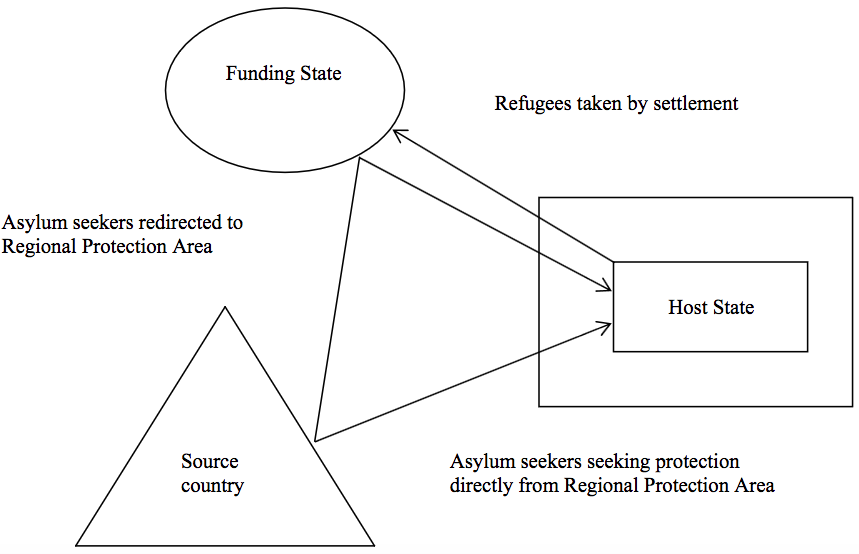
- Asylum seekers that arrive spontaneously in a funding State returned to the appropriate Regional Protection Area for protection.
- Intervention [1] in source countries to stem flows and enable safe and sustainable return as soon as possible.
- Long term solutions by managed resettlement schemes for those most in need.
5. Element 1 – Regional Protection Areas
5.1. The basic principles of Regional Protection Areas
Regional Protection Areas are areas where asylum seekers and refugees can find protection. They would be open to any asylum seeker from an agreed list of nationalities in the region and accept returns of asylum seekers of those nationalities who had applied for asylum elsewhere. They would be operated by an international organisation but hosted by a Nation – State. They may arise in response to a particular refugee situation or they may exist more permanently, able to accommodate whatever is the latest flow. Processing for resettlement would operate in the Protection Area enabling certain refugees to be resettles elsewhere.
5.2. Effective Protection
Under this vision Regional Protection Areas must provide effective protection. Unfortunately there is no international agreement on what constitutes effective protection and UNHCR have recently started a debate on this point linked to their Convention – plus agenda. Even without full agreement it is clear that at a basic level there must be primary humanitarian assistance – food, shelter, and health services – and there must be no risk of persecution or refoulement to the source country. In order for the UK and the rest of the EU to use Regional Protection Areas the notion of effective protection must also be sufficient to be compliant with Article 3 of ECHR. This means that there must be no risk of torture, inhuman or degrading treatment, either directly in the Protection Area itself or by removal from the Area.
The Regional Protection Areas would not be ‘international territory’ rather they would be controlled by an international organisation, probably UNHCR (see paragraph 10.5). As far as possible the Protection Areas should not be refugee camps rather they should offer the opportunity for refugees to live as normal lives as possible. In some cases a Regional Protection Area may mean an area where refugees can live with additional international assistance. In other cases it may mean providing dedicated support and housing for refugees in a controlled area. In all cases no one would be forced to remain in the Protection Area. However, the host State would have the right to remove any asylum seekers found elsewhere on their territory to the Regional Protection Area.
We would probably want to provide some form of access to education and work in the Protection Area. However, this provision will need to be balanced with the provision of such benefits to the host community to ensure that refugees are not viewed as receiving better treatment (see paragraph 5.3). Particular care will need to be taken to ensure that women and children are safe in the Protection Areas. There is considerable evidence to show that in many such refugee situations women and children become subject to sexual abuse and exploitation. It will also be important to ensure that combatants do not gain access to Protection Areas and the Areas are not used for military purposes. Eliminating these protection difficulties will be challenging but experts suggest that in most cases the problems can be overcome by better funding and management of protection.
5.3. Location of Regional Protection Areas
The Protection Areas would ideally be near to source countries to enable to swift repatriation. However, they could be anywhere, including in the UK. Potentially Regional Protection Areas could be set up in an area of a source country itself. As the Protection Areas would not be places of detention they would need placed in accepting communities. Importantly the sitting of a Regional Protection Area should not cause destabilisation in the region. We know from experience, particularly in central Africa, that large numbers of refugees in a region can cause knock-on conflicts. There may need to be a range of Protection Areas to deal with the different nationalities and ethnic groups in the region.
Also, there is a clear link to the general development standards in the region. The basic humanitarian assistance a Protection Area provides should not be significantly higher than the local communities’ resources otherwise it will act as a magnet to those in need in the surrounding area and cause resentment. However, if the standards in the Protection Area are significantly lower than the surrounding communities’, refugees may decide it is better to live illegally in the region than receive the allocated protection.
Countries would be persuaded to host a Regional Protection Area largely because they are probably dealing with a large refugee population already. The international community would therefore offer to support that refugee population in a better way. The host country gains further because the establishment of the Regional Protection Area is coupled with real international efforts to end the refugee flows and stabilise the region. In return the international community would expect the host country to allow back into the Protection Area asylum seekers who had arrived elsewhere. Resettlement opportunities would be offered to the genuine refugees if the situation was protracted and help offered in integrating the remaining refugees into the region and removing the unfounded claimants (see long term solutions in paragraph 8).
5.4. Processing in Regional Protection Areas
On establishing a Protection Area the host State, funding State, funding States and international protection organisation would agree the list of nationalities and ethnic origins for which the Protection Area would cater. Any asylum seekers of these nationalities or ethnic groups could go there and claim asylum. Other nationalities and ethnic groups could be accepted where the international organisation, host State and funding States agreed to do so. There would be initial screening to establish identity, register and check for security risk cases.
In the medium to long term it would be necessary to decide whether those arriving qualify for protection. However, in the short term, perhaps for the first 6 months, temporary protection could be provided to all without any determination of status. Ideally processing would not be necessary because the asylum seekers will be able to go home quickly and it is more efficient to provide for all rather than determine claims.
Where processing is necessary it would be the UNHCR body who undertake the processing. They should be operate a transparent and fair decision making process using trained officers. Ideally advice would be available to the claimants but there would not need to be a right to a legal challenge to the decision. As UNHCR would be an independent body the only remedy would be an administrative review of the decision, perhaps by a senior board on the papers only.
If the claim is unfounded there would need to be removal from the Area. If the claim is founded then a place in the Regional Protection Area is secure. Ideally they would only need to remain in the Regional Protection Area for a short period of time before they can return home. If the protection need is long term then other options will need to be pursued (see paragraph 8)
5.5. Coping with the Protection Demand in the Regions
If Regional Protection Area operate an open door policy to asylum seekers of certain nationalities it may be difficult to provide sufficient capacity to meet the protection need in a region. This may be because of a sudden mass influx situation. Or it may be because there are already large numbers of refugees in the region and Regional Protection Areas cannot be built up immediately to cater for all the refugees.
In these circumstances it may be necessary to have different grades of protection available in the region. Initially the focus would be to provide a base level of protection for all in need along the lines of current UNHCR activity in the regions. The next step would be to look to improve the quality of protection available at least in one area aiming to reach a level whereby returns from Europe in compliance with EHCR would be feasible. This grade A Regional Protection Area would be reserved for two primary groups : firstly, asylum seekers that arrived spontaneously elsewhere and who are returned from other States for protection and processing; and secondly, those classified as particularly vulnerable and who are likely to fit the criteria for a resettlement place. It follows that resettlement processing would primarily operate from this grade of Regional Protection Area.
Having two grades of Regional Protection Areas would make the situation more complex and would necessitate restrictions on access and differentiated registration procedures. Ideally it should be viewed as a short-term staging post on the road to effective protection for all.
6. Element II – Returns to Regional Protection Areas
6.1. Return by the safe third country principle
Returning asylum seekers that spontaneously arrive in the UK to a Regional Protection Area for protection is a key part of the vision. It works on a principle similar to that of safe third countries. We would be saying that asylum seekers do not need protection in the UK because there is another safe third area where they can access adequate protection in the UKI because there is another safe third area where they can access adequate protection. The principle works within the Geneva Convention framework.
The safe third country notion is now relatively well accepted and practised internationally
and in the UK we have recently extended its use to those arriving from the accession countries. However, it would be a step further on to extend the principle to artificially created internationally controlled areas that are Regional Protection Areas. As we do not yet have anything quite like Regional Protection Areas there is no clear authority from the courts as to whether they would be regarded as sufficiently safe for returns. Nevertheless, the indications are encouraging. The High Court has accepted that it is possible to return a Kosovan to the UN protected area in Kosovo [2]. The Immigration Appeal Tribunal recently found the opposite on return of an Iraq Kurd to the protected areas in Northern Iraq [3] but he case is being appealed to the Court of Appeal. Lawyers suggest that the presence of the UN may be the key difference as they provide protection in Kosovo, whereas in Northern Iraq the safe area is more State-like.
To ensure that return to Protection Areas are possible we will need to place test cases before the courts at an early stage. Yet, there are action we can undertake that should persuade the courts that returns to Regional Protection Areas are legitimate and safe.
6.2. Legitimising Return
The most important factor in legitimising return is to ensure that the protection provided in Regional Protection Areas is truly effective protection. Particularly at the outset, when there is no evidence of experience, we will need to be able to demonstrate that there are systems in place so that no-one is refouled from a Protection Area and that no-one is subject to persecution inside the Area. Here the tri-partite agreement between the host State, funding States and international protection organisation (see paragraph 10.1) will be significant. It will set out how protection will be provided, by who, and will show the commitment of the funders to the continued provision of the protection.
We will also need UNHCR. Although the actual protection in Regional Protection Areas could be provided by another organisation we need the endorsement eof UNHCR in returning asylum seekers to the Protection Areas. If UNHCR consider the Areas to be inadequate for returns or they disagree with the principle then we will have difficulty persuading the courts that it is acceptable. The best solution would be for UNHCR to make a public statement expressing their satisfaction with Protection Areas and returns to them.
We will probably also require an amendment to domestic legislation. Section 12 of the Immigration and Asylum Act 1999 includes safe third countries provisions. We should add Regional Protection Areas to these provisions specifying, in secondary legislation, which nationalities can be returned to which Areas.
6.3. The practicalities of Return
Returns to Regional Protection Areas would operate on a similar basis to current safe their country returns. When asylum seeker makes a claim, say at Dover, he would have a screening interview. His fingerprints would be taken and his nationality established. Where he is from a nationality allocated to a Regional Protection Area he would be informed that he will be removed to a Protection Area and given the opportunity to consult a lawyer prior to removal. He would be taken into detention whilst his removal to the Protection Area is arranged.
Challenge to removal to a Protection Area would be by non suspensive appeal from the Protection Area itself. Prior to removal the asylum seeker would, as always, be able to bring a judicial review action. As far as possible the High Court should be able to deal with these applications swiftly as under the current non-suspensive appeal arrangements.
3 Magdheed
6.4. The deterrent effect of Return
Returning asylum seekers to Regional Protection Areas should have a deterrent effect on economic migrants and others, including potential terrorists, using the asylum system to enter the UK. However, the deterrent effect will only be significant where there is a sufficient coverage of Protection Areas and there are reduced opportunities for asylum seekers to claim to be of a different nationality in order to avoid removal.
Consideration will therefore need to be given to establishing Regional Protection Areas in regions where there are not large numbers of refugees yet there is a large demand for economic or other migration to the West which results in abuse of the asylum system. Here Regional Protection Areas may operate much more as of territory processing centres. There would only be a few people who need to access the Protection for protection daily. Largely the Protection Areas would cater for those who claimed asylum spontaneously in the West and their claims are then processed in the Regional Protection Areas. The regions bordering the new enlarged EU may be particularly relevant for these types of Regional Protection Areas.
7. Element III – Intervention
7.1. A true end-to-end process
In the proposed global vision it is vital that a hostilic approach to refugees is taken. The
system must be truly end-to-end beginning with reducing the need to flee and continuing
until sustainable return or integration elsewhere has been achieved. Therefore the
establishment of a Regional Protection Area must be coupled with development, respect for
human rights and conflict resolution activity in the region. In addition the pressure to
migrate and refugees should be a factor in all development and other intervention activity.
7.2. Preventative action
The best solution for refugees is that there should not be any refugees and no-one should be forced to migrate. Therefore the international community should be working to reduce refugee flows before they occur by working to improve human rights adherence throughout the world.
We know that human right standards are closely linked with development and in this context the international community already focuses on these issues, for example by funding from the World Bank. Action also happens at an EU and individual State level. Development activity is rightly focused on assisting the most poor, rather than those most likely to become refugees, but there is a significant overlap between these two groups and we should continue our efforts to understand the links between development and forced migration. In this context the work of the WTO and IMF and wider trade, economic and diplomatic relations between States are all relevant.
We also know that conflict produces refugees and now FCO, DfiD and MOD have a joint target to improve the effectiveness of conflict prevention where the UK can make a significant impact. Since the end of the Cold War NATO is also redefining its role to include peace-keeping operations. This can be key in enabling potential refugees to stay or return to the region.
Any coercive intervention in other States is of course controversial and the frequently quoted examples of Kosovo and Rwanda, highlight the lack of an international regime that governs such intervention. In response to Koffi Annan’s plea to the international community to reach a new consensus on when such intervention is justified the International Commission on Intervention and State Sovereignity (ICISS) was formed [4]. They concluded that State sovereignty implies a responsibility for the protection of its people. Where a State is not undertaking this responsibility due to war, repression or State failure, and the population is suffering serious harm, then the international community has a responsibility to intervene. They term such intervention ‘the responsibility to protect’. Such intervention should be preventative as far as possible, always proportional and include a responsibility to rebuild.
In terms of truly assisting refugees the ICISS proposals go to the heart of the matter by imposing an international responsibility to protect persons in their source country. Under this vision, the ICISS proposals should form part of a new asylum system. However, many nations are much more wary of an interventionist stance than the UK and adoption of the Commission’s proposals by the UN is not foreseen in the near future.
7.3. Enabling Repatriation
Where there are refugees we should work to make their protection need short term only. UNHCR is clear that the best solution for refugees is repatriation in their home country and this should be the aim of the new system.
Where refugees are subject to persecution from the State, resolving the problem may mean changing or ultimately removing the regime. We know that this is difficult to achieve and can require significant intervention hence leading to all difficulties mentioned above. Where refugees are subject to non-State persecution the situation may be slightly easier. Here it is necessary to persuade and enable the State to take action to protect the individual. We may be able to take action to improve the law enforcement agencies of the State or perhaps the international community could provide the in country protection necessary for certain groups. There is a scope for a more innovative approach here. For example, by working with relevant NGOs we may be able to support women in a source country who would otherwise be persecuted.
To ensure that every Regional Protection Area is coupled with intervention funding States should create an intervention action plan. Such action plans would be specific to each refugee producing situation. They would draw together for a whole raft of actions that impact on the aim of enabling refugees to go home as soon as possible. In this context they should be linked to an exit-strategy for each Regional Protection Area.
8. Element IV – Long term solutions
8.1. Resettlement Quotas
Even with a clear commitment to repatriation it is unlikely to be possible in all cases and for all refugees. Intervention will not be possible or wholly successful in every situation. Resettlement will therefore be necessary to enable a number of refugees to be moved outside of the region and integrated into another State. Resettlement schemes are a key part of the Regional Protection Area package agreement. They are important not only as a way to provide long term solutions for refugees but also to enable States to share the burden of refugees. All those States that wish to use Regional Protection Areas to protect asylum seekers that arrive spontaneously on their shores should be required to operate resettlement quotas.
Resettlement quotas should not be negotiated on the basis that all Regional Protection Area residents would gain resettlement. The majority of refugees, as now, would remain in the region. Yet, the size of resettlement quota should be sufficient to demonstrate that funding States are committed to refugees. Certainly the number accepted by resettlement must be greater than the number of spontaneous arrivals that are returned to the Regional Protection Area otherwise criticisms of ‘dumping’ on the developing world will be well founded. Funding States should share the burden by taking some refugees under resettlement and then by providing funding and assistance to the remaining refugees in the region. The balance between the resettlement quotas and funding for refugees in the region would probably be different for each refugee situation.
8.2. Operating Resettlement Schemes
As resettlement would be organised on a quota basis it follows that resettlement cannot be a right. The UNHCR body would consider resettlement for refugees according to set criteria. Again, their processes should be fair and transparent but there would be no legal appeal available. States should take the needy through resettlement schemes. If they wish to cherry pick refugees they should do so by their economic migration routes. There is no reason why information of economic entry routes to the West could not be available in the Regional Protection Areas.
Funding States will probably also want to undertake their own screening of resettlement applications for security purposes. Terrorists can already be excluded from Geneva Convention protection under the Convention but States may wish to impose tighter restrictions on resettlement. This screening could take place within the Protection Areas or from the funding States themselves.
8.3. Integration of resettled Refugees in funding States
Funding for resettlement should come from, as far as possible, community groups in receiving countries sponsoring refugees. Under this model community groups would pay for the costs of resettlement and provide support for the refugee on arrival helping them to settle and integrate in their new home. The community will therefore have a stake in resettlement and there will be people to welcome refugees to the UK.
However, the refugees are likely to need language training, information about the systems, rights and responsibilities in their new home and assistance to find work. As integration is a two-way process between immigrants and host communities, the cost for the training of refugees needs should be shared between the taxpayer and the refugee themselves. This is covered in more detail in the Future of Migration work.
8.4. Local Integration in the Region
The alternative long-term solution for refugees is to be integrated locally into a State nearby their source country. This happens extensively already either informally by refugees simply establishing themselves in a neighbouring State or with the support of UNHCR for example in West Africa. It is likely to remain important under this vision because in a protracted refugee situation Funding States will not be able to take all refugees by resettlement and some refugees are likely to prefer to stay in the region.
Local integration can be very successful, particularly where it is supported by integration assistance, as refugees are able to remain near their home in a culture that is probably not that unfamiliar to them. However, care always needs to be taken that Host States are not overwhelmed. By establishing Regional Protection Areas in the regions funding States will be seen to have greater responsibility for providing long-term solutions for the refugees in the Protection Areas. Therefore, efforts to support local integration will need to be included within the protection package and balanced careful with both the development needs of the region and the size of resettlement quotas.
8.5. Returning Unfounded claimants
Within Regional Protection Areas there are likely to be a proportion of asylum seekers who do not qualify for protection. It will be the responsibility of the UNHCR body to remove these persons from the Regional Protection Area. Ideally the number of non-genuine refugees should be low, as the living standards in the Area should be similar to that of the source region. Where removals are necessary voluntary assisted removals should be pursued as far as possible.
To enable returns the challenges of persuading States to accept back returnees and arranging the necessary documentation for return will remain as in the current system. Therefore, within the Regional Protection Area package negotiations with source countries will be important. Again, ideally such negotiations should be easier than at present because removal from Regional Protection Area, as opposed to removal from the UK, will not lead to the same consequential loss of remittance income. As the failed claimant will be in the Region physically arranging removal should be less complex than in the current system.
8.6. Lifetime of Regional Protection Areas
If Regional Protection Areas are not suitable for long term residence then they should only exist for a limited period of time. However, we know from experience that many refugees live in camps for decades for example in Tanzania. It is here that the package approach to Regional Protection Areas is important. The establishment of a Regional Protection Area must be coupled with intervention efforts in the source country and resettlement schemes must be in operation. The continued existence of a Regional Protection Area should focus the mind on efforts to secure long term solutions for the refugees.
In establishing a Regional Protection Area it should be made clear that the Protection Area is not intended to be permanent. There should be regular reviews of the situation and the goal should always be an exit strategy linked with the intervention action plan.
9. The Context
9.1. Managed migration
A new global asylum system should be considered in the wider context of a managed migration system. Moving asylum towards protection and away from migration is not designed to achieve near zero migration. In this visionary world movement of highly skilled workers on a global scale is largely without constraint. For lower skilled workers there would be more limited opportunities but a number of training and development places across the world would be available. Global movements are encouraged but the aim in all cases is to assess applications for entry before the person arrives on the territory.
Managed migration schemes are generally not linked to source countries of asylum. However, they are clearly communicated so that anyone fleeing persecution could easily find out about such routes. Training and development placements may be linked to source countries as part of the overall development package for that country.
9.2. Residual Domestic System
Moving to a system of Regional Protection Areas is an alternative way for States to provide for asylum seekers who arrive on their shores. However, it will never become an absolute substitute for having a domestically operated asylum procedure. This is because it is unlikely that the proposed Regional Protection Areas will have a complete global coverage. New conflicts or human rights abuses arise all the time and there may not be a suitable Regional Protection Area available to cope with that region or with the level of demand. Without a safe place to return asylum seekers we are obliged to test whether it is safe to return an asylum seeker in compliance with Article EHCR.
The benefit of the Regional Protection Area proposal is that it should gradually reduce spontaneous arrivals of asylum seekers leaving the domestic system dealing with residual cases only.
9.3. Dealing with Illegal immigration
The proposed vision for asylum is concerned with better protection for refugees and reduced abuse of the system. It should also have some effect on reducing illegal immigration. At present traffickers can demand a high price for their trade because any illegal entrant is guaranteed accommodation and a small allowance when they arrive on the UK claiming asylum. If claiming asylum simply returns the migrant to their region of origin they are likely to choose to live illegally from day one of entry. But in this scenario the immediate economic gain is less certain and perhaps more people will conclude that the traffickers’ fees are a bad gamble.
However, even with the effect of this proposal, there is likely to remain a high demand for illegal immigration. The Future of Migration work indicates a growing demand for migration from the developing to the developed world the report proposes policies to deal with this.
10. The Governance of the Protection Package
10.1. The tri-partite agreement
In order to make Regional Protection Areas operational there are three key parties involved:
- Funding States
- Host States
- International protection organisation
Each of these parties has a specific role to play but the relationship between the three will need to be negotiated and managed. There will need to be an agreement signed between the parties setting out the responsibilities of each party for each Regional Protection Area. This agreement will be a detailed document specifying the extent of the Regional Protection Area, the protection it provides and to whom, the funding arrangements, and the action to be taken if any party fails to comply with their obligations. Assuming we work with UNHCR such agreements could be signed under UNHCRs authority to make tri-partite agreements on asylum.
10.2. Funding States
Funding States are those States who wish to use Regional Protection Areas as a form of off – territory protection for refugees and asylum seekers. They are the funders of Regional Protection Areas and are key players in the intervention work in source countries.
The UK would be such a funding State. However, it would be expensive and possibly and ineffectual to act alone. We need a coalition of States as funders. One possibility would be to make the operation of Regional Protection Areas packages an EU agenda – the new vision for the Common European Asylum System. Another possibility would be to work with our fellow English speaking nations such as the US, Canada and Australia. At least initially a small coalition is likely to be more practical.
10.3. Funding States – Coalition working and Burden Sharing
Funding States would need to work closely together as coalition. They need to act with one voice in all their relationships with the host States and the international protection organisation.
One of their first tasks will be to address burden sharing on resettlement quotas, on funding to run the Protection Area and on intervention activity. For resettlement quotas funding States should agree to take a proportion of the total resettlement quota agreed with the host State. The proportion for each funding State should be dictated by factors such as population size and GDP rather than related to the numbers of spontaneous asylum seekers that the States currently receive as we know that these numbers fluctuate. However, if the courts in one State do not allow returns to the Protection Area then this State should be allowed to subtract any spontaneous arrivals from their resettlement quota.
The funding for the Regional Protection Area should again be divided by a formula. As there is a relationship between funding levels and resettlement quotas then the funding and resettlement formulas should also be related.
The sharing of the burden of the intervention action related to refugee protection is unlikely to be appropriate for a formulatic division between funding States. This is because there are other factors that will influence intervention and it will not be solely undertaken by funding States. Here costs are likely to stay where they fall although funding States may wish to collaborate more closely on intervention then they have traditionally to date.
In order to deal with these complex coalition arrangements there may need to be initial agreement between the coalition members prior to making the tri-partite agreement with the host State and international protection organisation. This would clarify the responsibilities within the coalition and help disagreements to be resolved at an early stage.
10.4. Host States
Host States are a key part of the Regional Protection Area package. They should be much more actively involved than simply allowing a Regional Protection Area to be established on their territory. As far as possible protection should be provided through the Host States with international assistance. We do not want to diverge from current development practice and impose protection from the outside without engaging the local community. Ideally a host State will be a signatory to the Geneva Convention but if they are prepared to work with UNHCR then this will not be an absolute necessary.
It should be remembered that host States are likely to have a multitude of difficulties to deal
with as well as an influx of refugees. The relationship with a host State will need to be
managed in a holistic way recognising that support for refugees is just one element of that
relationship. Any extra support offered to host States as part of the Regional Protection Area
agreement will need to be considered both in light of the needs of that host State but also
with regard to how that assistance will be viewed by other developing countries who may
also have similar needs but do not have the same refugee burden.
10.5. International Protection Organisation
To achieve the new vision we want an organisation to run the Regional Protection Areas that carries real legitimacy in protecting refugees, sufficient that can persuade the courts, host and funding countries, that they will adequately assist and protect refugees and operate a fair and transparent processing system. The organisation should also be responsive, capable of delivering in difficult situations and able to relate well to both host and receiving States.
The obvious organisation to do this is UNHCR. They are well placed to organise the protection of refugees in Regional Protection Areas and to operate resettlement schemes as they are already doing so throughout the world. It would not require a significant expansion to their work to undertake the Regional Protection Area proposal. The proposal also fits neatly with their Convention – plus idea. Although UNHCR is not necessarily as efficient and responsive as we would like it to be the forthcoming Convention – plus and the Forum provide us with the opportunity to mould UNHCR into the organisation we would wish it to be. As now UNHCR would remain primarily a protection agency and it would be funded on that basis. Yet, it would be increasing its role in determining claims and returning those whose claims were unfounded.
10.6. Cross – Government Approach
As the proposed vision promotes an international solution to asylum it will change the way asylum operates in the UK. Asylum will no longer remain the primary concern of the Home Office; the ECO and DfiD will increasingly need to be key partners. The twin aims of providing effective protection in the regions and creating managed flows to the UK should be reflected in the objectives of all three Departments.
11. The Costs
11.1. The Costs Objective
The aim of the proposed asylum vision is to provide more effective protection for global refugees and create more managed flow. It is not designed to save costs. Rather it is designed to spend resources more sensibly.
In the new vision we should be redistributing the money spent on processing in the West and spending it on protection in the Regions. For the financial year INDs budget is around £2bn around half of which is spent on asylum support. If just half of this asylum support spending was saved the resulting £0.5m would almost double the entire annual budget of UNHCR (currently around £0.6bn). We are not looking to siphon funds from DfiD. DfiD should remain focused on poverty reduction but should with the additional refugee protection funding ensuring that there is co-ordination of activities in host States.
To achieve this redistribution of funds it would first be necessary to inject funding into the regions in order to create Regional Protection Areas that enable spontaneous asylum seekers to be returned there. The resulting savings in the UK will depend on how many asylum seekers can be thus re-routed or deterred from applying for asylum in the UK.
The commitment to intervention, which is part of the Regional Protection Areas package, is also not a money saving proposal. However, we are already committed to much intervention action that is justified by our wider desire for global poverty reduction and a more stable world. Refugees simply provide a further reason for these activities.
11.2. Negotiations with Host States
For Regional Protection Areas there are likely to be complex negotiations with host States. This could involve ‘compensation’ for hosting the Protection Area and the level of this compensation is likely to vary significantly depending on the needs and demands of each host State. Costs of running the Protection Areas themselves will be more than protection, but it should not be significantly more.
One key factor in the funding formula with a host State will be the balance between resettlement places and funding for local integration. It is here that the issue of burden sharing between North and South is at its most acute. It can be argued that it is legitimate for Western States to expect neighbouring States to absorb all the refugees in the region of the Western States provide the necessary funding. However, as we in know, successful integration of large inflows of refugees is not simply a question of money.
The numbers of refugees that will need to absorb by resettlement to avoid these local integration problems will vary on a case by case basis. We should wary of creating precedents whereby host States expect Western nations to take a set proportion of refugees in all circumstances. However, we should be generous with resettlement to show that we are not using money to enable us to wash our hands of the refugee problem.
12. Reaching the Vision
12.1. The Key Challenges
The proposed vision of a global network of Regional Protection Areas is a long-term vision. Achieving it also brings challenges that we will need to address. The key challenges are:
- That it will not be possible to provide Regional Protection Areas with a level of protection that is sufficient for the courts in Europe to recognise the protection as sufficient to safeguard human rights. If the courts do not consider the Areas safe then it will not be possible to send asylum seekers there for protection and processing.
- Persuading countries in source regions to allow Regional Protection Areas to be established will also require careful planning. There is a risk that States will not be prepared to host Protection Areas. There is also the possibility that Protection Areas would cause destabilisation in the region or damage development objectives and these risks cannot be overcome by funding.
- More generally, the vision requires considerably more international co-operation on refugees than has been witnessed in recent decades and international confidence in collectively managing problems. This will be challenging both in gathering funding partners for Protection Areas and in the relationships between funding States and States hosting Protection Areas.
12.2. Piloting the Approach
Given these challenges we need to begin to move towards the vision by piloting the proposed approach. We should seek to establish one or two Regional Protection Areas and evaluate their effectiveness. This will require us to work in two stages:
Firstly, we will need a cross – Whitehall group to work-up the initial UK led parts of a pilot and decide who we wish to approach as funding partners and how we want to approach UNHCR. This Whitehall group will include Home Office (IND), FCO, DfiD and HMT. There may also be a role for MOD where there are links to conflict situations. Another player may the CO EU Secretariat as we consider how far this vision should form part of European Common Asylum System.
Secondly, we, as the UK, will need to work with the funding partners, host States and UNHCR on implementation. This will require an international working group gathering the key players together.
13. Stage One of Establishing Pilot – Whitehall Working
13.1. Selecting the Location
The first task of the Whitehall group will be propose a few potential locations for Regional Protection Areas. This is an important and difficult decision. From the Home Office perspective it will be important to choose locations from the top ten-asylum seeker producing countries so that there is maxim potential for reducing unmanaged flows to UK. In fact we may wish to site on Protection Area near to source countries of particular need and place another Protection Area, perhaps nearer the EU to deal more with economic migrants. However, as our aim is also to provide more effective protection to those remaining in the region we will want to carefully consider how Protection Areas in our chosen locations will achieve this. Our choice of pilot locations will send out signals of whether we are more concerned with diverting flows or providing protection abroad and this should be remembered.
We will need to select host States who we think can be persuaded to have Regional Protection Area on their land and in fact who may benefit from hosting such a Protection Area. In doing this we will need to consider the development of the region as a whole and how refugee protection will relate to any other assistance we are providing in the region. We will also need to consider how practical it will be to provide Article 3 quality protection in the region.
In selecting a location we will also be influenced by the likely enthusiasm of funding partners for working in particular region. Here factors such as numbers of asylum seekers, colonial links and other political links between potential partners and the region will be important.
Locations that have so far been proposed but have not yet received any detailed consideration are:
Iraq – Regional Protection Area in Turkey, Iran or Northern Iraq through Turkey / Iran Somalia – using Northern Somalia as a protected area for the South North Africa – Protection Area in Morocco for Algerians and other Africans in transit Ukraine or Russia – Protection Area primarily for those in transit to the EU Balkans – still a problem area, but would a Protection Area help. Zimbabwe – a problem but not one recognised by its neighbours so where would we put a Protection Area
13.2. Costs
It is clear that initially the pilot projects will require an injection of funds and that the costs will vary significantly from region to region. In 2002 UNHCR spent $15.5m in the Middle East, £75.8m in South Eastern Europe and $100.6m in the East and Horn of Africa. To provide effective protection in these regions these figures will need increasing. A useful indication may be UNRWA (United Nations Relief and Works Agency for Palestine Refugees) who provide support and assistance to over 3.9 million registered Palestinian refugees in the Middle East. Their expenditure in 2002 was $296m.
Once the locations of the pilots have been selected ball-park figures should be created for the pilots. We then need to consider how a funding formula might operate between the coalition partners covering both costs and resettlement quotas.
13.3. Choosing Funding Partners
Here the choice is primarily European or English speaking nations as partners. Given our commitment to a European Common Asylum System it makes sense to pursue this vision through Europe. However, the asylum and immigration debate is relatively advanced in the UK compared to most of our European neighbours and we may not find enthusiasm for this vision throughout the whole of Europe. Given that working with 15 or 25 partners is also cumbersome we may want to select the more likely European enthusiasts and work with a coalition of say 5 partners.
Amongst the English speaking nations, Australia have been making noises that indicate that
they may be willing partners. The USA and Canada have less of an asylum problem and
therefore may be less willing to participate. If we chose to work with only Australia we may
want to consider how a close liaison between Australia and UK immigration policy would be
viewed.
13.4. Approach to UNHCR
The proposed vision is unlikely to be a complete shock to UNHCR as it is closely related to their Convention – plus thinking. However, certain elements of UNHCR at least are unlikely to welcome the proposal of returning asylum seekers to the regions for protection and processing. It is important that UNHCR are on board, as we need their endorsement of Regional Protection Areas. It may be best to make an initial approach from the UK and then use UNHCR to get other States on board. However, it is more likely that UNHCR will be persuaded if we first gather some partner States and propose a well worked pilot proposal to them.
14. Stage Two of Establishing Pilot – Working with Partners
14.1. Working Up the Protection Package
The main task for the coalition of funding States together with UNHCR will be to work up the protection package. Prior to approaching the potential host States there will need to be a relatively worked up package that will form the basis of negotiations. This should cover the division of responsibilities between funding State, host State and UNHCR, the form and level of protection available to refugees and any assistance to the hosting community. It will cover the number of resettlement together with assistance given for local integration.
14.2. Links with Intervention
A key part of the Protection Package is the work in the source country to stem flows and enable refugees to return. All this intervention work will not be undertaken by coalition itself rather there will be other international organisations and other States involved. The first task will be to find out what actions are already occurring or planned in the source country. The coalition will then need to consider what other actions, if any would be helpful in making the source country safe for return. Where appropriate the coalition should then lobby the necessary organisations or States for the action required or if possible undertake that action themselves. Before the pilot is brought into being there should be an intervention action plan in place.
14.3. Approach to Host States
The approach to a host State is important and will need careful handling. Ideally the protection package should be worked up in close collaboration with them s they are perhaps the most significant party. Yet whilst working with them funding States will no doubt want to ensure that they negotiate an appropriate agreement.
14.4. Agreements, Endorsement and Legislation
UNHCR are already able within their mandate to create tri-partite agreements between States and themselves. Therefore the accumulation of all the work on the protection package should lead directly to the signing of an agreement between the funding States, host States and UNHCR. Either within or in addition to this agreement UNHCR will need to make a statement endorsing the safe nature of the Regional Protection Area. In the UK, and no doubt in the other funding States, legislative changes will also be needed to enable returns to the Protection Area. Once this is in place the pilot can be put into action.
15. Timetable
15.1. Feeding in Convention – Plus
Our best opportunity for getting UNHCR on board with the proposal asylum vision is through their emerging concept – Convention-plus. Detailed discussion on Convention-plus will take plus when the Forum is established. It appears that the Forum will be open to largely funding States who may be interested in making tri-partite agreements between themselves, UNHCR and other States. The first meeting of the Forum is likely to be in early summer 2003 – the date has not yet been set. Prior to then, on 10 February, Ruud Lubbers is coming to London. This would be an ideal time to propose the vision and pilots to him. Discussions outside of UNHCR on defining Convention –plus are already in motion primarily in the IGC. The IGC is a group of the main EU States plus Norway, Switzerland, USA, Canada and Australia who meet to discuss their asylum concerns. On 3 February the Dutch are leading a small group of IGC in further discussions and this may again be an opportunity to raise our proposals.
15.2. Feeding into the Future of Europe Convention
In the future of Europe Convention we are pushing to have the Lisbon agenda reflected in the Treaty and this probably remains the best way forward. We can work with a few other Member States on piloting the vision in the near future and if the pilots are successful the Lisbon language in the Treaty should leave the door sufficiently open for a fuller EU approach to the vision in the longer term.
If we make our approaches to other Member States in the next few months this will provide the opportunity for us to assess the response to the vision whilst the Future of Europe Convention is still at work. Although we would not wish the Treaty language to tie us to the proposed vision until after the pilots have been evaluated there may be the opportunity for Council conclusions to steer a course towards the vision if we can get other Member States on board. It is the Council in early 2004 where this is likely to be appropriate.
15.3. Timetable for the Pilots
Once we have agreement from other funding States, host States and UNHCR to pilot the proposed vision it will be important to keep the momentum up. Working as a coalition is notoriously slow and if we are not careful it could take years to set up just one or two pilots. Not only will we need to keep pressure on UNHCR we will need to ensure that legislation in other States does not slow the process.
The pilots themselves ideally need to run until the protection package has worked itself out of a job in the region or until alternative protection has been found for all in need. To complete our understanding it will be important to continue until an exit strategy has been worked through. However, initially we will no doubt wish to time-limit the pilot. This will require careful negotiation with the host State and UNHCR to ensure them that we are not committing only for a short period to then withdraw and leave them with large numbers of refugees with little support.
15.4. Evaluation
Evaluation of the pilots should occur at set points throughout the lifetime of the agreement not just at the end of the pilot. This is important given the complexity of each stage of establishing the pilots and the length of them. If the early signs from the pilots are encouraging we may wish to establish other Regional Protection Areas before the pilots have been concluded.
16. Communications Strategy
16.1. The Dual Message
Given the complexity of the views on asylum and the vast number and variety of views and standpoints on the subject, communication of the vision and the pilots will be very important. The starting point should be the two aims of the new system; firstly that we want to be able to better and more equitable protection to refugees, and secondly that we want a more managed system that is less open to abuse.
16.2. Mulitple Audiences
In addition to those actually involved with implementation of the pilots, clear messages will need to be communicated to:
- The international community and in particular the developing world. We will need to be clear that the new vision is not about ‘dumping’ asylum seekers on the poorer nations.
- The EU. For the vision to form part of the Common European Asylum System in the long term we need to show that it is fair and legitimate way to manage flows of asylum seekers.
- Parliament and the UK public. In the UK it will be important to demonstrate how the vision will reduce abuse of the current system and spend money more wisely to help those really in need.
- Asylum Seekers and Traffickers. With Regional Protection Areas we want to deter asylum seekers from arriving in the UK therefore we will need to clearly explain that those who arrive spontaneously will be returned to a Protection Area.
- NGO’s. To NGOs it will be important to stress the quality of protection in the Protection Areas and the controls that we will put in place to ensure that the protection is adequate. We will also need to emphasise the resettlement schemes and show that they are generous and focused on those in need.
17. The Pilots and Domestic Processing
17.1. Maintaining the Focus
Piloting the proposed protection package will necessitate a new injection of both energy resources. However, it must be remembered that its effects will not be immediate nor will it completely wipe out the need for the current asylum system. Therefore, we must maintain the focus on improving our domestic processes as well as working on making the pilots a success. Particularly in the area of removals the links between the current asylum and the proposed vision are strong. We already know that we need to work and negotiate with source and transit countries and there should be a crossover here between negotiating for removals and negotiating for Regional Protection Areas. In fact in no area should there be tension between improving domestic processing and moving towards the vision. The goal is always the same – more effective protection in a managed system.

